
Back to products
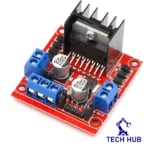
L298N Motor Driver Module
90.00 EGP
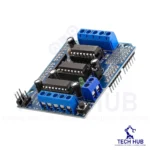
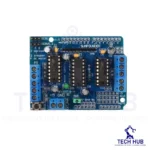
L293D Motor Driver Shield
85.00 EGP
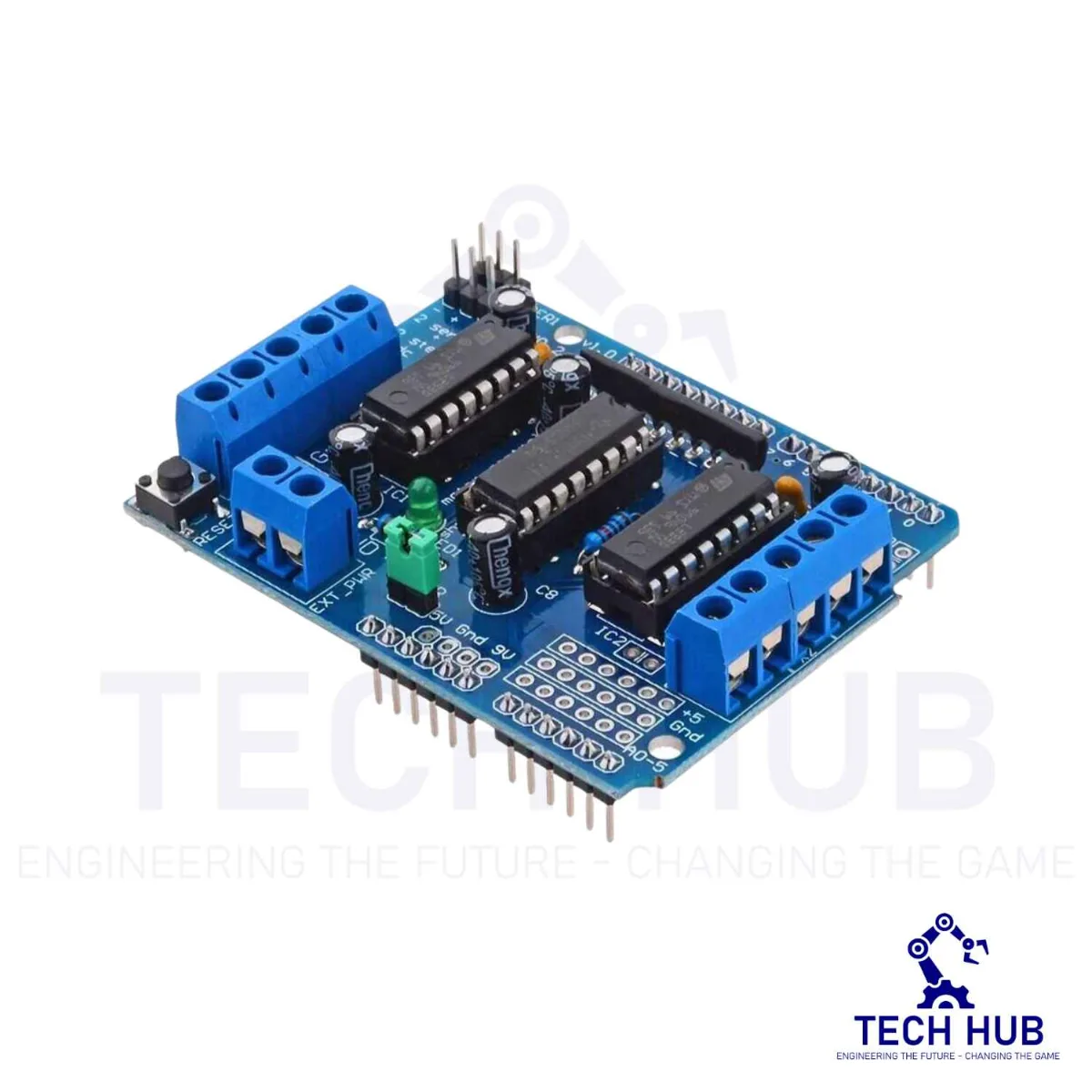
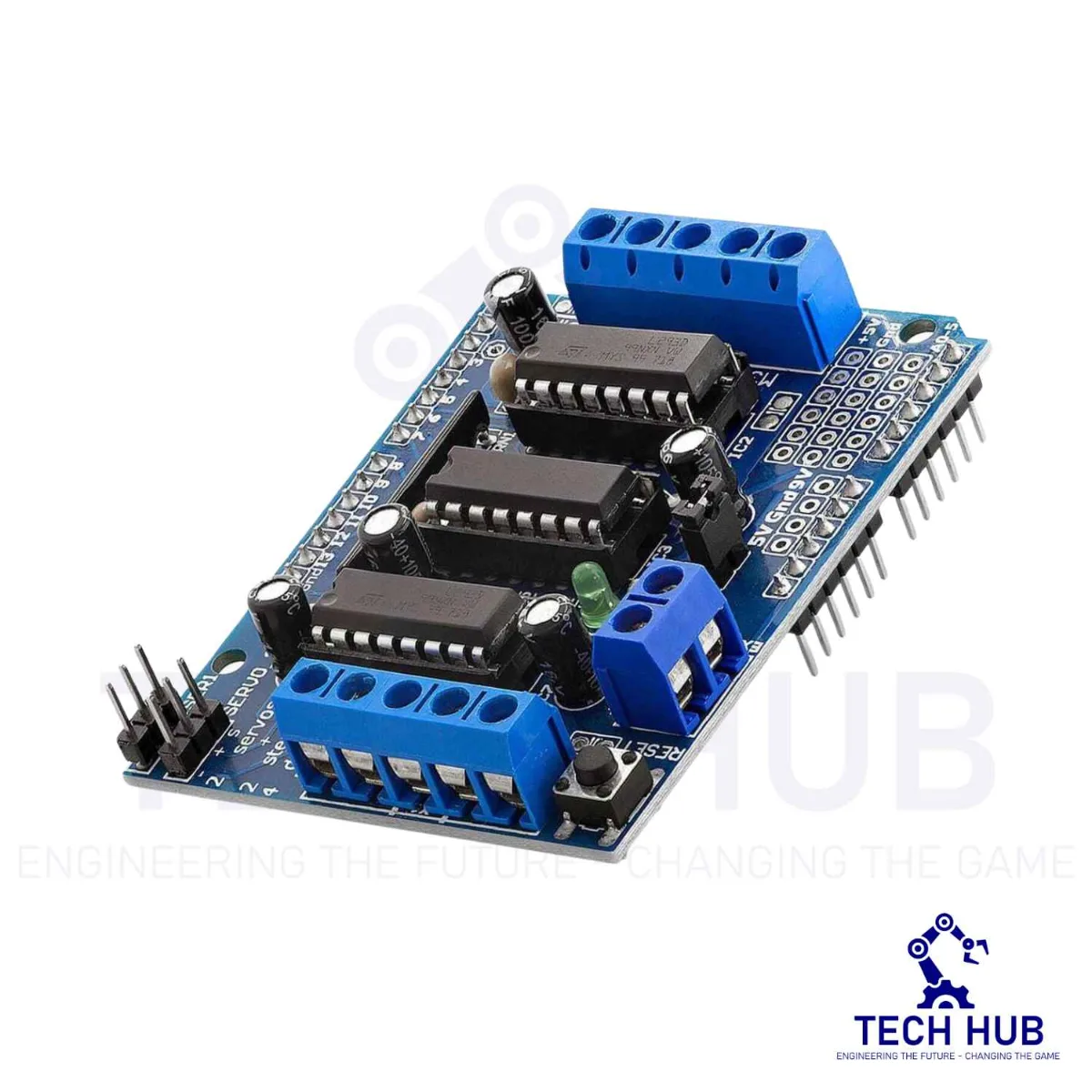
L293 Motor Driver Shield allows to control 4 DC motors or 2 stepper motors using Arduino kits. With adjustable direction and speed of rotation.
| Weight | 0.03 kg |
|---|---|
| Dimensions | 6.7 × 5.4 × 1.5 cm |
1 in stock
Description
L293D Motor Driver Shield
The module allows you to control four DC motors (DC) or two stepper motors using Arduino kits. The system allows to adjust the direction and speed of rotation of the motors with a current consumption of up to 600 mA.
Specifications:
- Drive 4 DC motors with speed and direction control
- Driver: 2 x L293D
- 74HC595 shift register
- Reset button
- 2 servo connectors
- 4.5 – 25V motor voltage range
- 1.2A peak current per channel (600mA continuous)
- Dimensions: 67 x 54mm
The L293D Motor Shield can drive up to 4 DC motors at voltages from 4.5 – 25V and at currents of up to 1.2A peak (600mA continuous) per motor with speed and direction control.
The module can also support up to 2 stepper motors. Each stepper motor takes the place of 2 of the DC motors, so you can run 2 stepper motors or 1 stepper motor and 2 DC motors or 4 DC motors.
The shield also technically supports 2 servo motors for which there are two 3-pin headers on the module. Unfortunately, it powers the servo motors directly off the Arduino 5V which is usually not a great idea. Doing so can overheat the Arduino on-board 5V regulator as well as induce electrical noise into the Arduino 5V power causing intermittent problems that are difficult to troubleshoot.
On the plus side, it does have a 100uF capacitor on these power pins which does help somewhat. If using this feature, use only with small servos like the SG90, and keep an eye out for any issues. As another option, the traces to the 5V center pins on the servo headers can be easily cut and rewired to a separate 5V power source or the motor source if powered off of 5-6V.
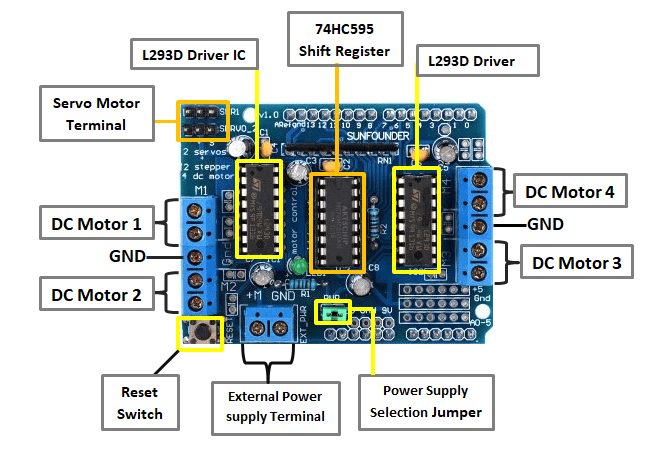
L293D DC Motor Power Connections
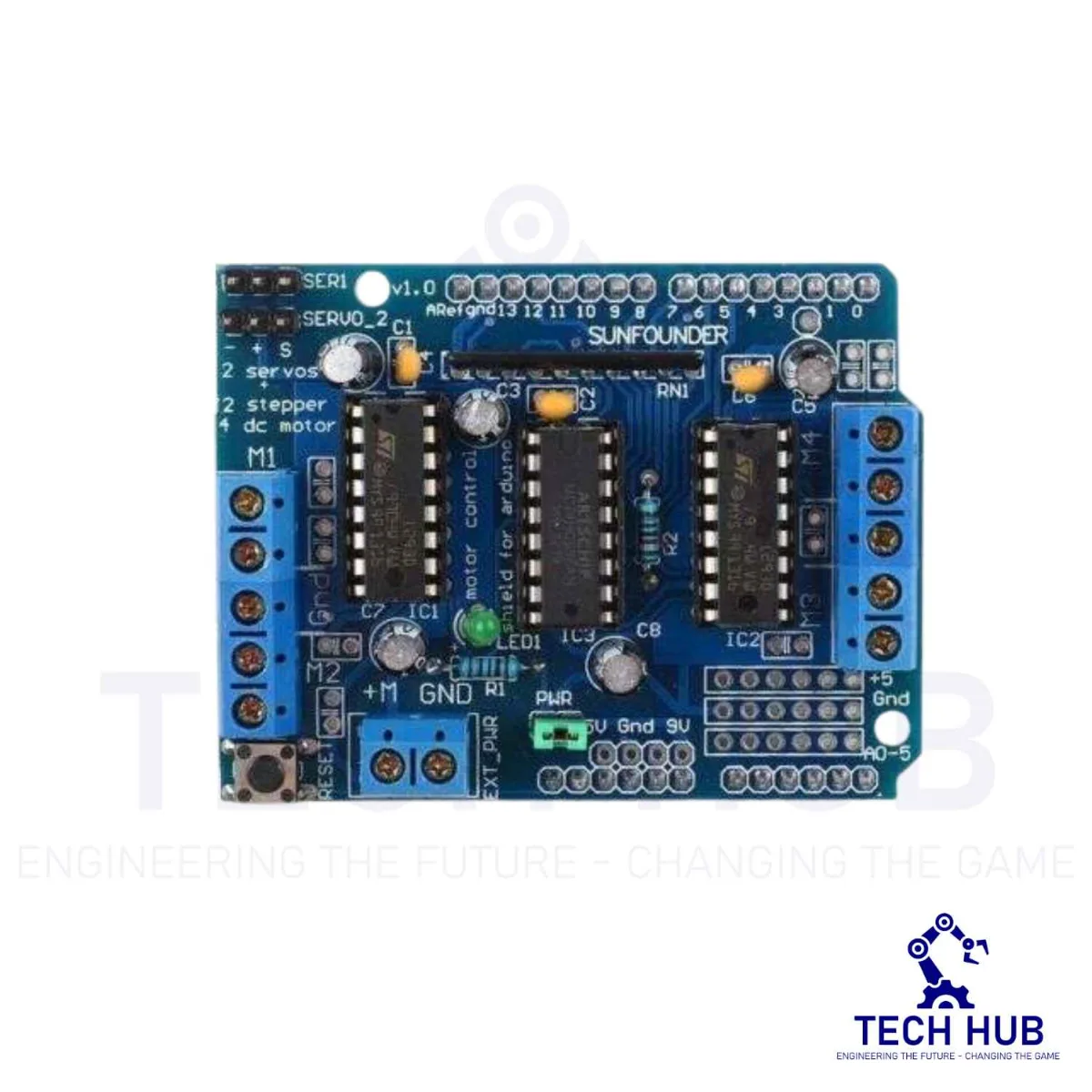
Motor voltage must be between 4.5 – 25V. This power can be shared with the Arduino or be separate. To select this, there is a jumper near the 2 terminal power connector labeled PWR.
When this jumper is installed, the power from the Arduino DC power jack is also connected to the motors. Vin (marked 9V on the board) is brought up from the Arduino to power the motors.
When the jumper is removed, that isolates the motor power from the Arduino and it must be supplied separately by connecting power to the 2 terminal power connector. Note: Do not apply power to the 2 terminal power connector with the jumper in place or it will short the two power supplies together!
1 x 2 Terminal EXT_PWR (Motor Power)
- +M = Motor Vcc which must be between 4.5 and 25V.
- GND = Motor Ground.
L293D DC Motor Connections
The motor connections are via two screw terminals for each motor and are labeled M1 through M4. The center terminal on the 5-pos terminal blocks are connected to ground.
The wiring of which lead of the motor connects to which terminal is somewhat arbitrary and relative to what you consider forward vs reverse motor operation. If the motor goes in the opposite direction that you expect, simply reverse the wiring.
1 x 2 Terminal M1 – M4 (DC Motor 1-4)
- Motor ‘-‘ positive lead
- Motor ‘+’ negative lead
Stepper Motor Connections
Stepper motors are typically 4 wires. Coil 1 will connect across one motor port such as M1 (M3) and coil 2 will connect across the other motor port such as M2 (M4). If the stepper motor has 5 wires, the center tap wire will be connected to the center ground terminal.
1 x 2 Terminal M1(M3) – M2(M4) (Servo Motor 1-2)
- Motor Coil 1
- Motor Coil 2
Arduino to Shield Pin Connections
The shield has a remote reset button located on it for easy access.
The shield uses Pins D3,D4, D5, D6, D7, D8, D11 and D12 for DC and stepper motor control.
D9 and D10 come out to the Servo headers. D10 is connected to Servo 1. D9 is connected to Servo 2,
The other pins are available including the 6 analog pins that can also be used as digital I/O. These have solder pads so that a header can be added if desired for easy connections. Next to that is a row of 5V and Ground connections that can also be populated with headers and can be handy for hooking up various sensors.
Useful Links:
Reviews (0)
Related products
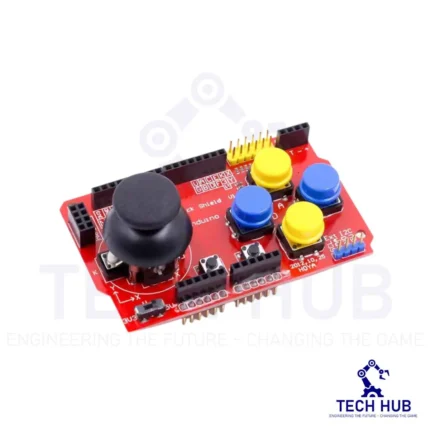
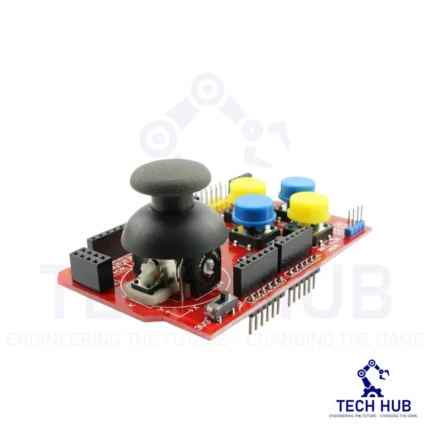
Arduino Joystick Shield
- Compatibility: Designed for use with Arduino boards.
- Joystick: Features a two-axis joystick for precise control in both X and Y directions.
- Buttons: Equipped with multiple push buttons for additional input options.
- Shield Form Factor: Designed to be easily mounted onto Arduino boards, providing a convenient and compact form factor.

Reviews
There are no reviews yet.